Author: arlsadmin
ARLS at 2019 ALA
The ARLS will host three sessions at the 2019 American Literature Association Conference in Boston. Also, please join us at our business meeting! Details are below.
American Literature Association
30th Annual Conference
May 23-26, 2019
Westin Copley Place
10 Huntington Avenue Boston, MA 02116
Literature and Ritual Thursday, May 23, 2019 1:30 – 2:50 pm (Great Republic)
Chair: Ryan Siemers, Southern Utah University
- “Making it Old: Ritual in O’Connor’s The Violent Bear It Away,” William Gonch, University of Maryland, College Park
- “Family Communions in Sarah Orne Jewett’s The Country of the Pointed Firsand Li-Young Lee’s ‘The Cleaving,’” Walter Hesford, The University of Idaho
- “The Uses of Ritual in a Time of Revolution: El Dios de los Reyes in Martin Delany’sBlake; or, the Huts of America,” Lucas Nossaman, The University of Tennessee
- “The 1920s New York Tabloids as Secular Liturgies,” Stephanie Redekop, The University of Toronto
Religion and Film Thursday, May 23, 2019 3:00 – 4:20 pm (Empire)
Chair: Catherine Rogers, Savannah State University
- “This is The Shackthat Job Built: Theodicy and Polytheism in William Paul Young’s Evangelical Bestseller,” Christopher Douglas, University of Victoria
- “The Tyranny of Masculine Creation and the Potency of a Replicant Adam and Eve Mythology: Postsecular Critique of Materialism in the Blade RunnerFilms,” David S. Hogsette, Grove City College
- “The Volatile Truth: Terrence Malick’s Thoreauvian Cinema,” Jonathan McGregor, U.S. Air Force Academy
- “Postsecular Signs: the disincarnate sign, the ordinary sacred, and transcendence in Jarmusch’s Paterson, Kogonada’s Columbusand Malick’s Tree of Life,” Caleb Spencer, Azusa Pacific University
Layered Identities: Women Writers and Jewish-American Identity Friday, May 24, 2019 12:40 – 2:00 pm (Great Republic)
Chair: Caleb Spencer, Azusa Pacific University
- “The Role of Jewish Identity for Wing’s ‘becoming a woman’ in Erica Jong’s Fear of Flying,” MyungJoo Kim, Chungnam National University
- “The Promise of God in Rachel Barenblat’s 70 Faces: Torah Poems (2011) and Elana Bell’s Eyes, Stones (2012),” Philipp Reisner, Heinrich-Heine-Universität Düsseldorf
- “In Praise of Cloistered Virtue: The ‘Orthodox’ Women of Kaaterskill Falls,” Makayla Steiner, The University of Iowa
Business Meeting Friday, May 24, 2019 2:10 – 3:30 pm (St. George C)
ARLS Officer Elections
The American Religion and Literature Society elects its officers every three years. Our next election will take place at our upcoming business meeting, which will be held at the American Literature Association conference on Friday, May 24.
We invite nominees for the following positions: President, Vice President, Information Officer, Media Officer, and Treasurer. Please send an email to kludwig@bsu.edu if you would like more information about any of these roles or if you wish to nominate yourself or a colleague. If you wish to run for a position, please submit a short statement of intent as soon as possible.
We ask that candidates for President or Vice President demonstrate a record of regular involvement with the ARLS. All members of the ARLS are eligible to run for the other three positions, regardless of previous involvement with the organization.
CFP – Ritual in Jewish Fiction
Organized by the American Religion and Literature Society
Midwest American Academy of Religion Regional Conference, March 1-2, 2019, Muncie, IN
With the birth of a modern culture in which instrumental reason plays a dominant role, the religious has tended to appear as a conscious adoption of a belief system. In Western cultures, in particular, we see the widespread reduction of ‘‘religion’’ to ‘‘belief.” And yet many traditions experience the religious not as belief but as practice. In Judaism, in particular, devotion is a matter of deed. When the Jews at Sinai accepted the Torah, they said. “Na’aseh venishma,”which translates as, “We will do and we will hear” (Exodus 24:7). The Jews’ unconditional acceptance of Torah and their submission to God’s law was expressed in a commitment to action. They were redeemed by their declaration, which acknowledges that obedience precedes understanding (Tractate Shabbat 88a).
This panel seeks to ask, How does fiction by Jewish authors show religious devotion enacted through ritual practice? We invite papers examining literary works that emphasize the importance of ritual, either through narratives in which ritual constitutes a meaningful aspect of characters’ religious experience or through formal elements that point the reader to the centrality of ritual. Areas of interest include but are by no means limited to Jewish American fiction, Yiddish fiction, science fiction by Jewish writers and Jewish feminist fiction.
Please send 250-word abstracts and brief bios to Kathryn Ludwig at kludwig@bsu.edu. Presentations should not exceed 20 minutes in length. The deadline for abstracts is November 1, 2018.
CFP – Critique and the Religious Turn in Literary Studies
Special Session
Examining the relationship between “postsecular” and “postcritical” methods. Have challenges to the secularization thesis reinforced, displaced, or revised the historicist/contextualist paradigm? 300 word abstracts by 10 March 2018; Ray Horton (rhorton3@murraystate.edu).
https://apps.mla.org/cfp_detail_11074
CFP “Race, Religion, and Post-Secularism in American Literature” – ALA 2018
In the recently published essay collection Race and Secularism in America (2016), editors Jonathon S. Kahn and Vincent W. Lloyd point to a conspicuous gap in, as well as sketch out an emerging sub-field within, the literature of (post-)secular studies in an American context: race and secularism. The book’s introduction poses the question best, “Why has whiteness characterized not only [the study of] the secular but also, all too often, critiques of the secular?” (5). In other words, scholars across disciplines, including American literary critics, have tended to prioritize and privilege the study of (post-)secularism’s relationship to white writers, literatures, cultures, histories, and subjectivities, as it also has unwittingly contributed to the marginalization and exclusion of ‘(O)ther’ non-white races that have long constituted the various sacred/secular landscapes from early America to our present day. (Post-)secularism and race are inextricably entwined within the literatures of America and thus require an American “turn” in our critical attention to more completely understand the entanglements of race and religion in post/modernity.
With this “turn” in view, the American Religion and Literature Society invites paper proposals that engage with, and explore, the sundry intersections between race, religion, and (post-)secularity in American literature. We encourage submissions from all American historical periodizations, literary movements, formal genres, and individual writers, as well as papers that address the various writings of American writers whose (non-)religious worldviews, racial identities, and (post-)secular writings help to shed new light on how we better understand race and religion in America. The panel indeed welcomes proposals that broadly interpret this topic and delve into its immense complexities, but with always an eye toward questions of race, religion, and all things (post-)secular in American literary cultures.
Please submit all abstracts to Kathryn Ludwig (kludwig@bsu.edu) by January 15. Be sure to include your name, institutional affiliation, email address, and any AV requests in your abstract. The subject heading of the email should be “Race, Religion, Postsecularism – ALA 2018.”
CFP “Literature of the Christian Left” – ALA 2018
A truth too often overlooked is that radicalism in the United States originally emerged from forms of Christianity that far preceded Marxism. The roots of American radicalism are religious and moral rather than scientific or dialectical. Moreover, print culture, from the days of the early republic to our own era, has remained the primary site where religion and the political, where word and action, thought and deed, have met to impel the transformation of individuals and the social order. Antebellum abolitionists used the medium to appeal to religious sentiment and the ethical imperatives of the faith to condemn racism and advocate for the liberation of all Americans. Transcendentalist ministers and Christian socialists published small magazines like The Harbinger, The Present, the Spirit of the Age, and The Dawn, among others, to disseminate anticapitalist polemics that were predicated on liberal theology and intended to encourage reforms that would broaden social justice in the young nation. Union organizers and rank and file workers wrote in a prophetic, religious idiom to denounce economic inequality and to portray the early labor movement as a necessary step toward establishing the kingdom of heaven on earth. The turn of the century reforms that defined the Progressive Era were initiated by the prolific writing of Christian socialists and proponents of the Social Gospel who also founded institutions dedicated to social justice, such as William Ellery Channing’s Christian Union Church, the Religious Union of Associationists and its Church of Humanity, Bouck White’s The Church of the Social Revolution, William Dwight Porter Bliss’s Church of the Carpenter, and the Church Association for the Advancement of the Interests of Labor, to name but a few. These radical religious publications and organizations were integral to labor reform and to the Women’s Rights movement. Susan B. Anthony was among Channing’s congregants, “whose teaching,” Elizabeth Cady Stanton wrote, “had a lasting spiritual influence upon” Anthony. Later, Dorothy Day would carry on this tradition with the Catholic Worker Movement. Later still, the historian William McLaughlin would argue that the upsurge of activism, spirituality, intentional communities, and moral recalibration in the 1960s, which contributed to the Civil Rights Movement and to the Sexual Revolution, constituted America’s Third Great Awakening. Today, while figures like Shane Claiborne and his brand of radical evangelicalism have rebooted the tradition of utopian practical Christianity for the new millennium, the power of the Christian left to initiate social change appears to be decidedly on the wane.
For this panel, in an effort to recover the role of religious radicalism in the social and political development of the nation, we seek presentations on any topic related to the history or literature of the Christian left in America. We also seek essays concerned with the present status of the Christian left and its ability or inability to be politically effective in America today.
Please submit 300-500 word abstracts to Kathryn Ludwig (kludwig@bsu.edu) by January 15. The subject of the email should be “Christian Left” and the proposal should include any A/V needs you will require.
Membership
Are you interested in becoming a member of the ARLS? If so, send an email to kludwig@bsu.edu. Membership is dues free. We will be posting our membership list to our website, and we would like to include as much information about you as you are wiling to share. This might include contact information, institutional affiliation, and research interests. We will list this information alongside the names of our members so that our website will enable scholars with similar interests to find each other and make connections outside of our presence at regional and national conferences.
ALA 2017
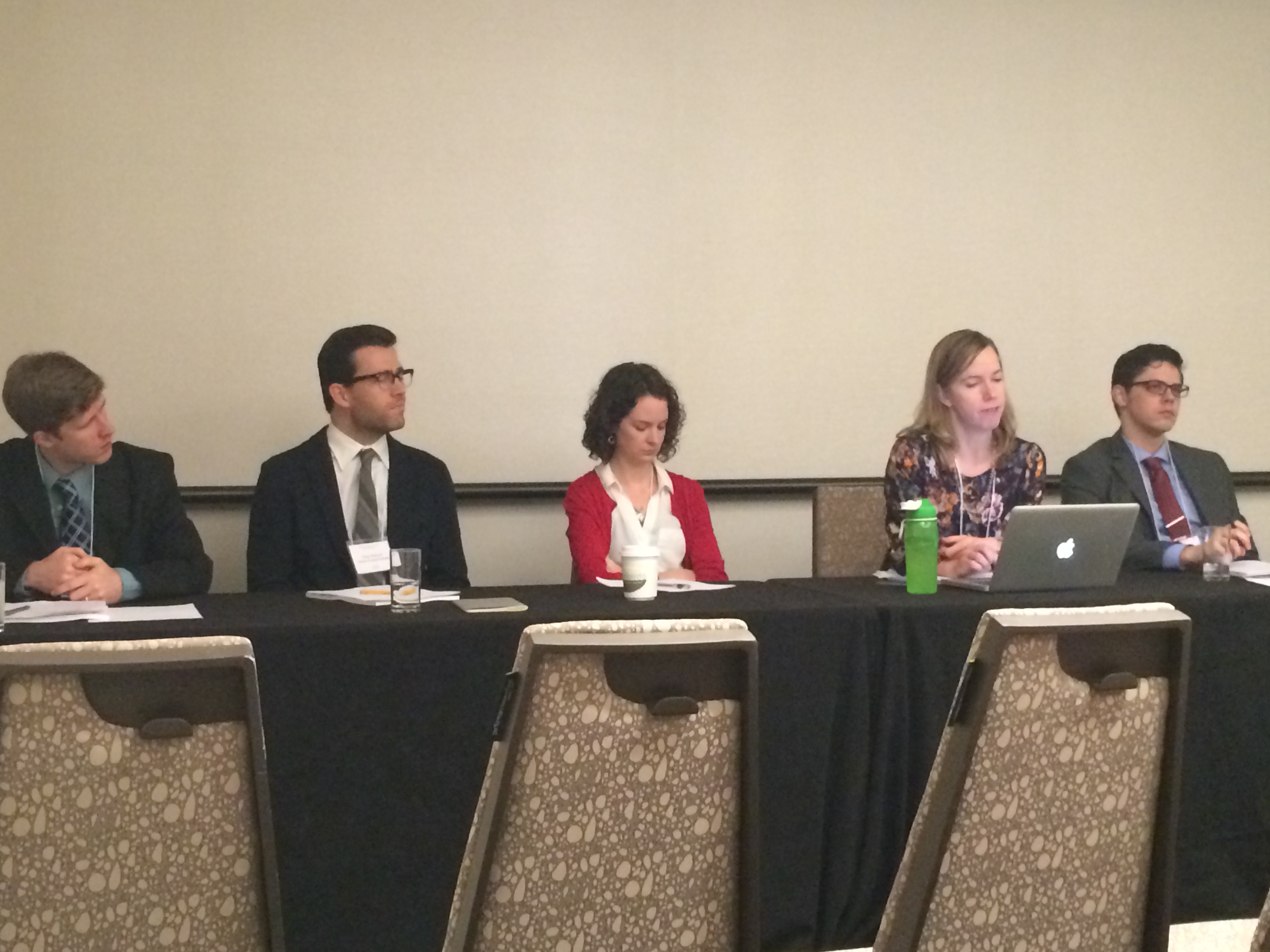
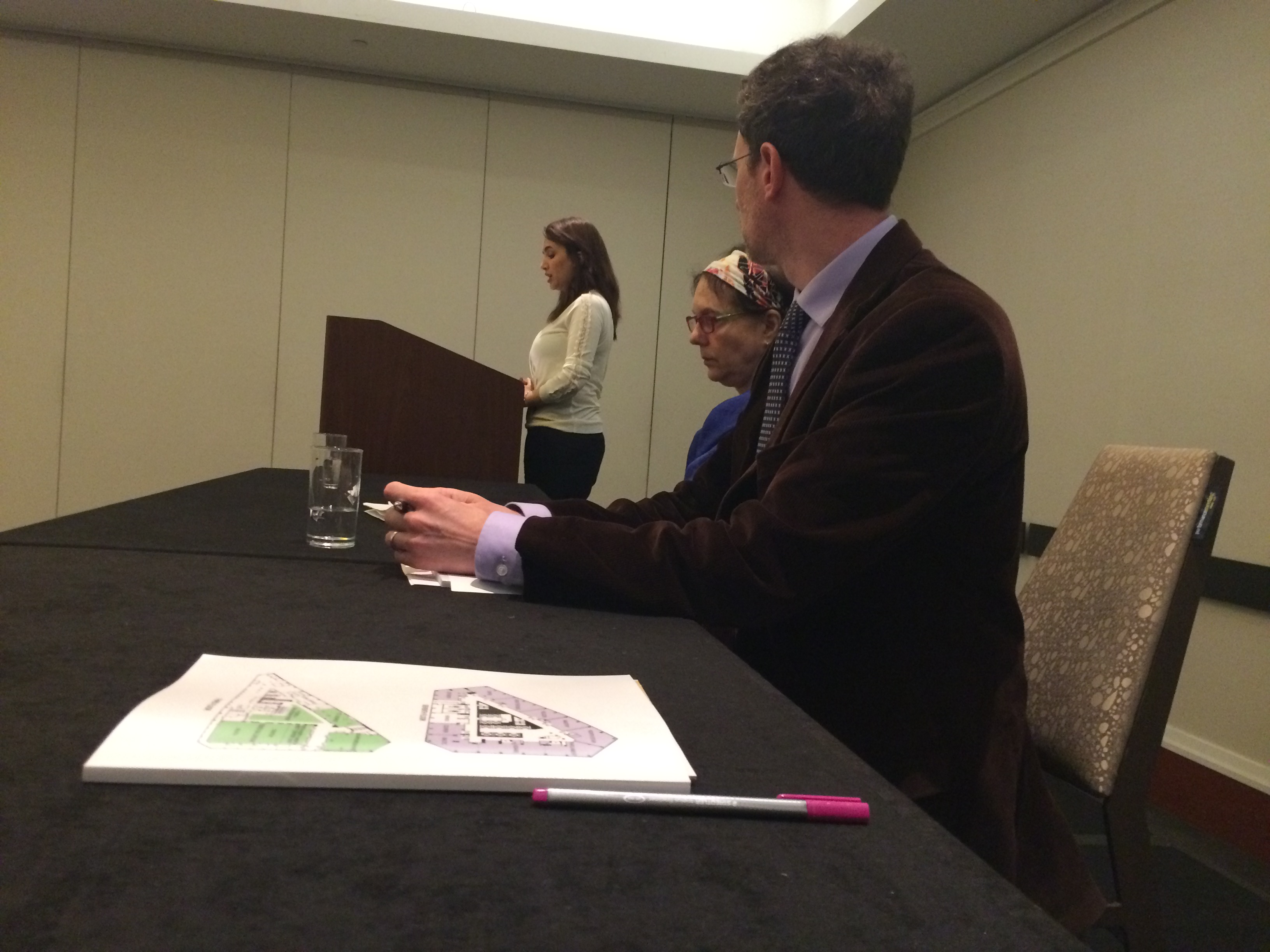
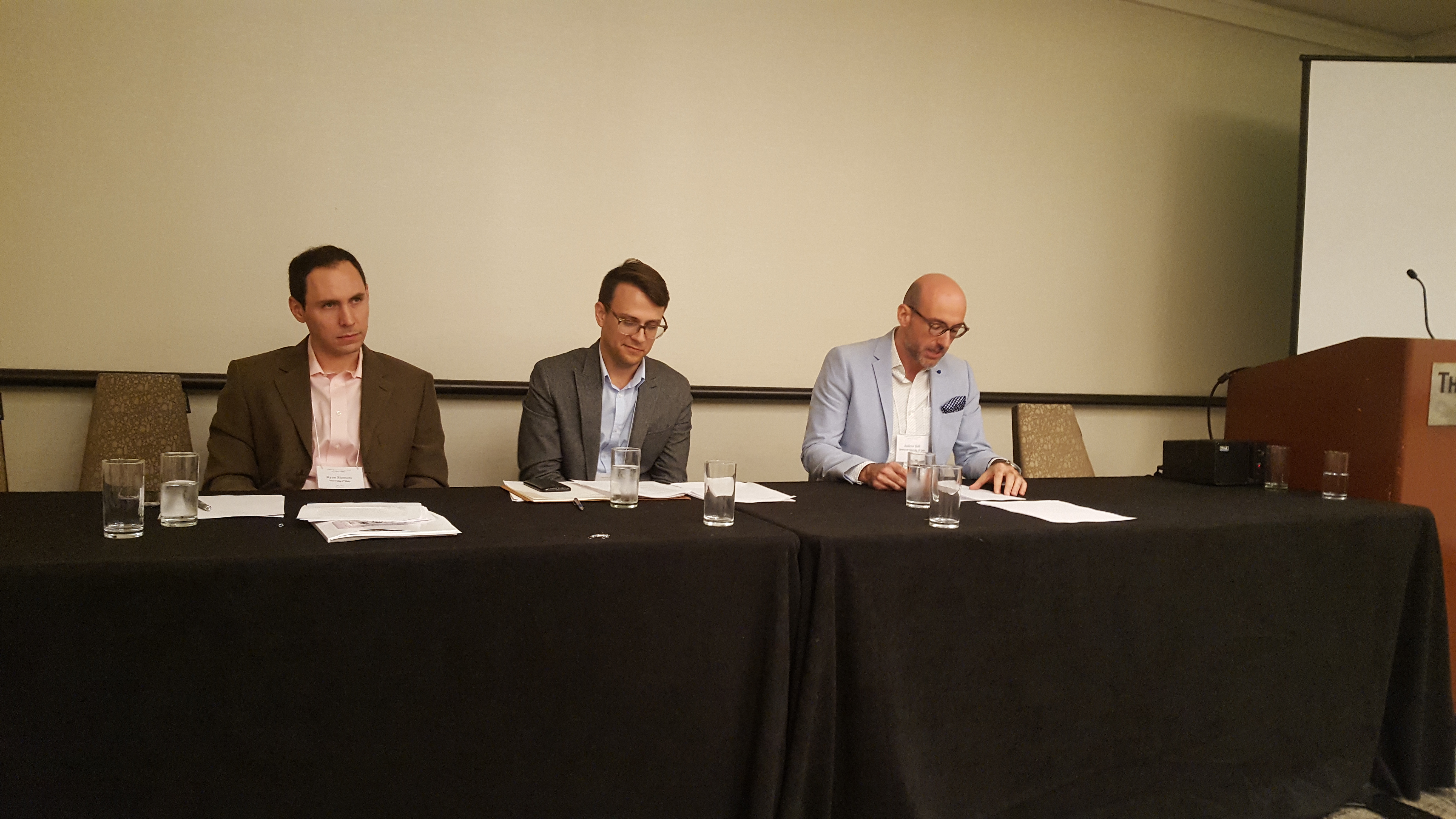
We had three excellent sessions at ALA this past weekend. Thanks to our presenters and to all who attended.
ARLS sessions at ALA 2017
The ARLS has organized three sessions for American Literature Association conference in Boston
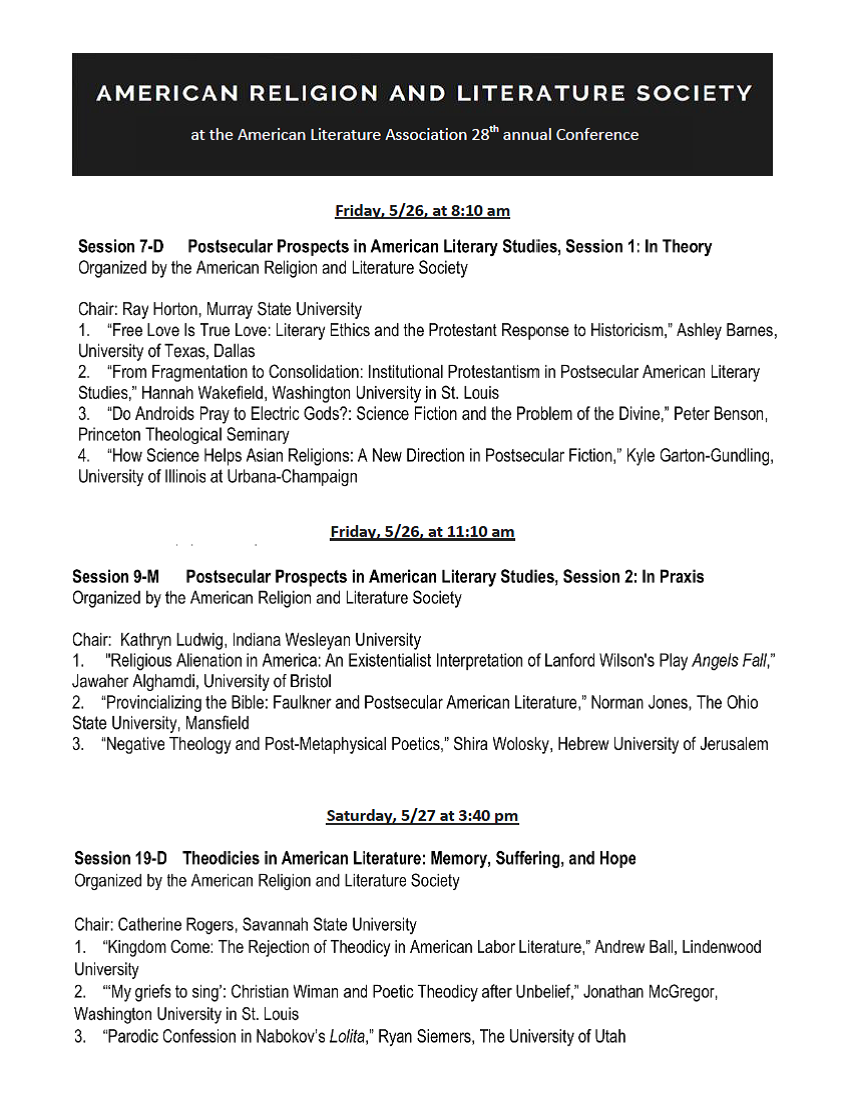
Friday, 5/26, at 8:10 am – Postsecular Prospects in American Literary Studies, Session 1: In Theory
Friday, 5/26, at 11:10 am – Postsecular Prospects in American Literary Studies, Session 2: In Praxis
Saturday, 5/27 at 3:40 pm – Theodicies in American Literature: Memory, Suffering, and Hope
We will also hold our business meeting on Friday, 5/26 at 5:10 pm.
See attachment for session details.
We hope to see you there.
 American Religion and Literature Society